Reliable field equipment is a core control in HDD and utility construction. It affects safety, compliance, production, and margin. HDD gives crews little underground visibility, so the drill, mud system, locator, telemetry, tooling, excavator support, and PPE must work as one system. U.S. requirements come from OSHA, PHMSA, and NTSB findings. Equipment failures can lead […] SolidSmack
Reliable field equipment is a core control in HDD and utility construction. It affects safety, compliance, production, and margin. HDD gives crews little underground visibility, so the drill, mud system, locator, telemetry, tooling, excavator support, and PPE must work as one system.
U.S. requirements come from OSHA, PHMSA, and NTSB findings. Equipment failures can lead to utility strikes, explosions, environmental releases, penalties, stop-work orders, injuries, and deaths.
Public MTBF data from OEMs is usually unavailable. Contractors should judge equipment by warranty, service access, diagnostics, telematics, parts lookup, training, and dealer support. The key buying criterion is recoverable uptime, not sticker price.
Incident records show the stakes. In Canton, Illinois, a directional drill hit a gas service line: one person died and 11 were injured. In an OSHA HDD case, a worker was killed by a drill bit during operation. In Lexington, Missouri, in 2025, an HDD strike to a 4-inch gas main caused an explosion, killed one child, injured several people, destroyed nearby homes, and shut off gas service to the town. On the Rover project, about 2 million gallons of drilling mud reached a protected wetland, and FERC later proposed a $40 million penalty.
The cheapest machine can become the costliest choice if it causes downtime, locate uncertainty, weak support, poor mud control, or thin documentation. Reliable equipment works only with maintenance, qualified crews, potholing or vacuum verification, real-time monitoring, spare parts, and emergency procedures.
Definitions and contractor scope
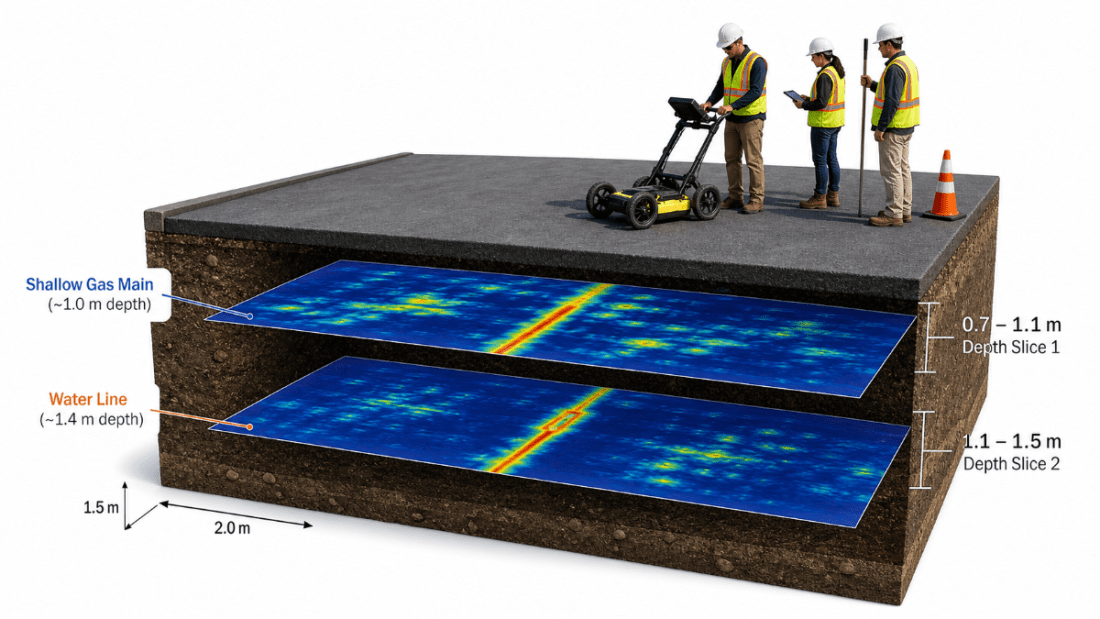
HDD is a trenchless method. Crews drill horizontally from the surface to install conduit, cable, or pipe. OSHA notes that HDD helps where open trenching is impractical or more hazardous, but it gives crews limited underground visibility. Utility avoidance depends on locating, potholing, and tracking.
ASTM F1962 and ASCE MOP 108 cover HDD use for telecom, electric power, natural gas, petroleum, water, sewer, and large crossings.
For U.S. utility contractors, typical HDD work includes fiber and telecom conduit, electric conduit and duct banks, gas mains and services, water and sewer crossings, streets, railroads, rivers, wetlands, potholing, utility exposure, restoration, and support excavation. Vermeer and Ditch Witch also position utility rigs for urban, residential, gas, and fiber work.
Reliable field equipment means more than mechanical durability. The full field system must maintain position control, fluid integrity, detection accuracy, communication, and serviceability under real crew conditions. HDD reliability therefore depends on the whole operating stack, not one machine.
Equipment reliability by category
The most important reliability question is not “Does it start?” but “Does it keep the bore safe, documented, and productive in congested utility conditions?” Industry consensus practices from Common Ground Alliance, ASTM International, American Society of Civil Engineers, and American Society of Mechanical Engineers, combined with OSHA, PHMSA, and OEM guidance, point to eight field categories that dominate outcomes.
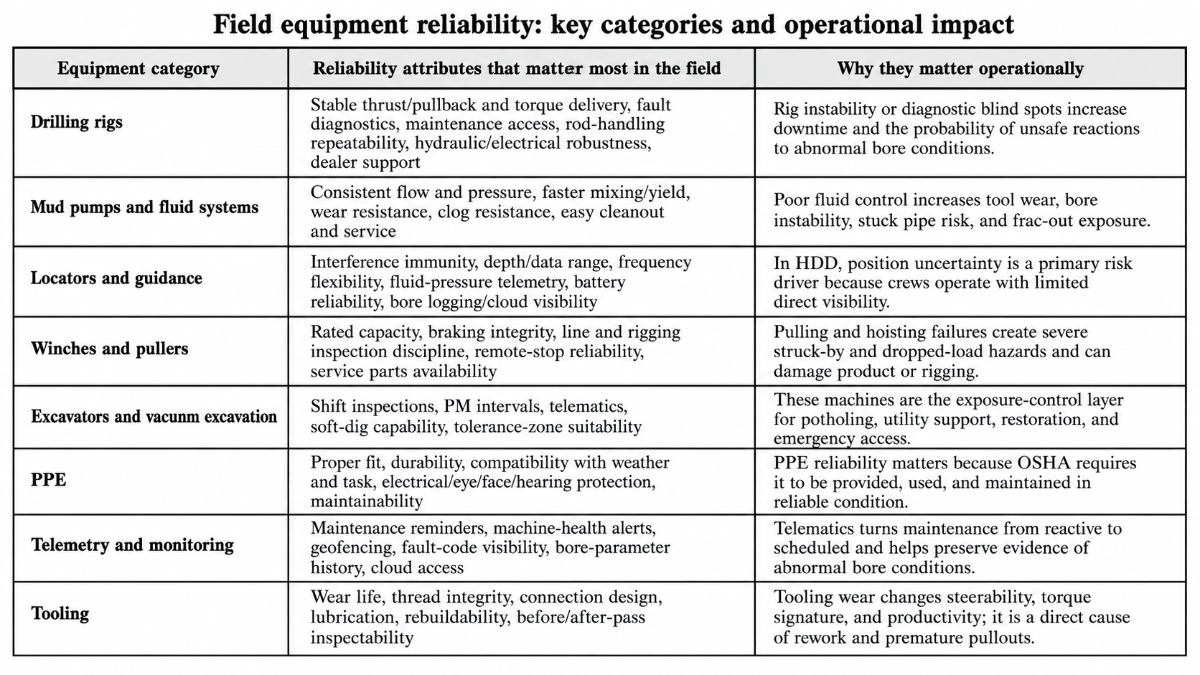
This table synthesizes OSHA construction rules, PHMSA HDD guidance, CGA damage-prevention materials, and OEM support content.
Public manufacturer pages are most useful when they are read as uptime signals rather than as marketing alone. Vermeer’s D24 utility drill publishes on-rig diagnostics and a standard 3-year/3,000-hour OEM extended warranty. Ditch Witch’s JT24 literature emphasizes maintenance access, low-grease design, onboard pipe capacity, and uptime-oriented serviceability. American Augers publishes a detailed warranty certificate with parts, labor, engine/transmission, and rack-and-pinion terms.DCI publishes explicit locator ranges, transmitter prices, and a long transmitter warranty. For contractors comparing HDD locating systems, digitrak falcon f5 should be evaluated by the same criteria: range, interference handling, transmitter support, service access, and field logging.
Standards and regulatory drivers
The regulatory baseline is stricter than many procurement processes assume. OSHA requires safety programs, regular inspections of jobsites, materials, and equipment by competent persons, employee training, safe utility-location methods near underground installations, and PPE that is provided, used, and maintained in reliable condition. The 2025 PPE update also clarified proper fit requirements.
PHMSA adds pipeline-specific duties. 49 CFR 192.614 requires pipeline operators to maintain written damage-prevention programs. 49 CFR Part 196 sets minimum damage-prevention rules for excavators. PHMSA also treats excavation as a covered task under Parts 192 and 195, so operators and contractors must be qualified for excavation work.
PHMSA’s HDD guidance links reliability to field controls. It recommends test holes along parallel facilities, full exposure at crossings where practicable, continuous drill-head monitoring with suitable guidance equipment, observation during pilot drilling and reaming, clear operator-locator communication, and stop-work when abnormal resistance or movement appears. It also suggests exposing gas facilities 12 inches below and 24 inches on each side at crossings, and keeping 12 inches of separation where possible. These are guidance practices, not universal federal mandates, but they affect equipment choice and crew procedure.
State law controls daily damage-prevention practice. All states require excavators to notify a one-call center before digging. The NTSB Canton report shows why state rules matter: Illinois required the directional-drilling crew to expose and visually inspect each crossing by hand or vacuum methods; the contractor did not. In South Carolina, PHMSA noted telecom and fiber work as the largest damage source and found that HDD contractors were not potholing enough before pipeline crossings.
Consensus standards should be used in procurement. ASTM F1962 and ASCE MOP 108 cover maxi-HDD design and installation. CGA Best Practices 21.0 is the main U.S. damage-prevention playbook. For winches, hoists, and rigging used in pipe pulling and support lifts, ASME B30 is the key reference for inspection, maintenance, and use.
Lifecycle cost and insurance effects
Public-data availability is uneven. Official OEM pages for the representative products reviewed publish specs, telematics functions, maintenance access, training, parts support, and warranty terms more often than they publish MTBF, warranty-claim rates, or field failure distributions. For that reason, contractors should treat public warranty and digital-support features as screening criteria, then require model-specific failure and service data during procurement.
A rigorous HDD lifecycle-cost model should therefore be built as:
TCO = purchase + finance + PM labor/parts + consumables + unscheduled repairs + downtime + restoration/rework + claims/compliance exposure + spare logistics – warranty recovery – residual value.
That formula matters because the incident record shows that a single failure event can overwhelm any apparent first-cost savings. The cost center to fear is not only the broken component; it is the combined effect of idle crew time, emergency response, utility-owner intervention, schedule slip, restoration, and potential penalties or litigation. Peer-reviewed construction management research also consistently treats machine-breakdown downtime as materially harmful to project and company performance.
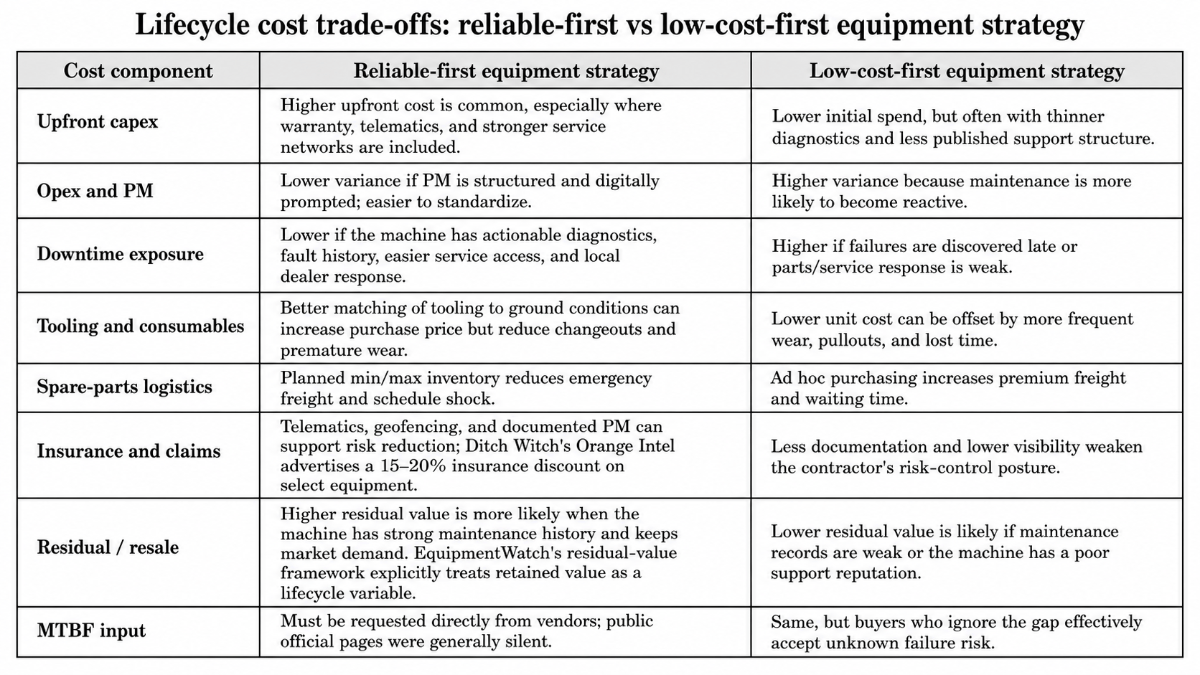
The direction of effect in this table is supported by OEM telematics/service features, OEM tooling guidance, and equipment-value sources, while exact dollars remain model- and market-specific. Public MSRP for many HDD rigs is quote-only and therefore unspecified in the reviewed official sources.
Insurance markets recognize that equipment reliability creates interruption risk. One major U.S. commercial carrier explicitly markets contractor’s equipment coverage for losses stemming from equipment-related delays and stoppage, and another insurer’s construction-risk resources point to telematics, equipment tracking, and fleet management as practical methods for mitigating construction losses. That reinforces an important point: equipment reliability is not only a maintenance topic; it directly affects insurability, deductibles, claims frequency, and underwriting confidence.
Procurement and maintenance actions
The procurement objective should be recoverable uptime under regulated field conditions, not lowest acquisition cost. That means buying the rig, mud system, locator, potholing capability, tooling, telematics, training, dealer SLA, and spare-parts plan as one package. PHMSA guidance on continuous monitoring and potholing, OSHA requirements for training and inspection, and the public incident history all support that system view.
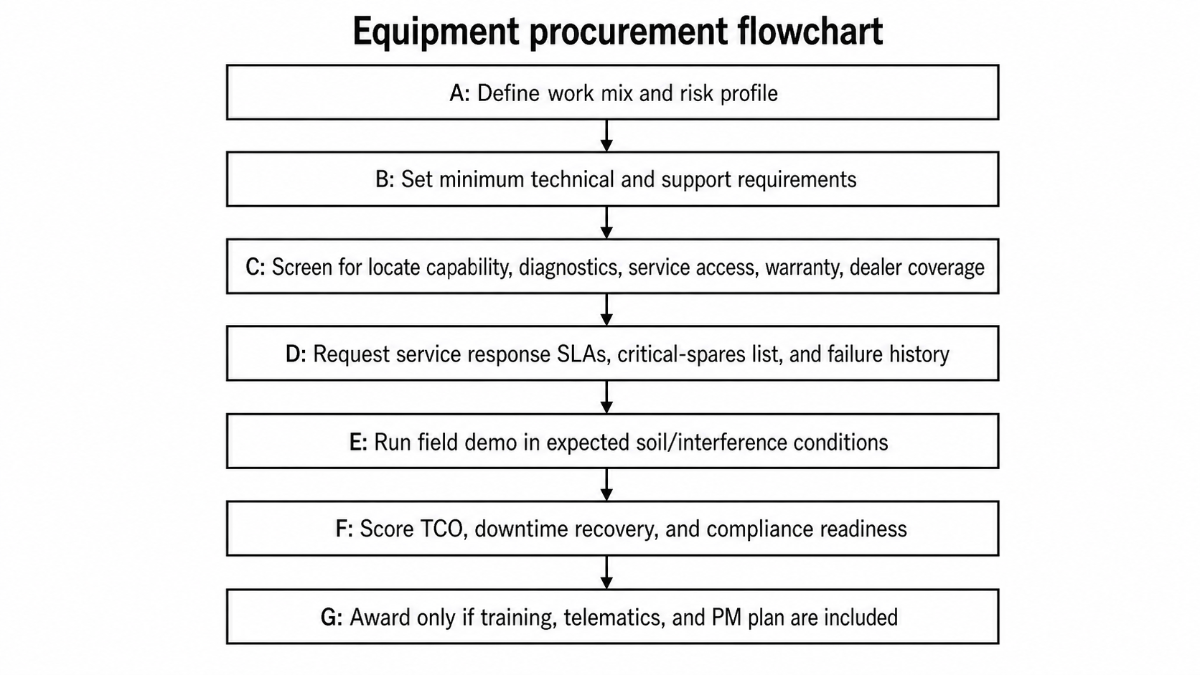
This is a recommended decision framework derived from the combined evidence, not a published standard.
Recommendations by contractor size
Small contractor. Standardize one rig class and one locator family. Prioritize local dealer response and training over maximum specs. Carry a spare transmitter, charger, batteries, critical hoses, filters, thread compound, and a backup locating plan. Use vacuum excavation by default at congested crossings.
Mid-size contractor. Put primary rigs and support excavators on telematics. Require documented PM. Maintain a critical-spares min/max list. Carry a second locator on critical bores. Use service contracts for main revenue rigs. Review failures and near misses monthly.
Large contractor. Centralize fleet analytics. Require vendor service-response SLAs. Keep fleet classes interchangeable where possible. Link bore logs, telematics, and incident reviews. Prequalify crews by documented operator and locator qualifications. Involve insurer risk engineers in theft, interruption, and maintenance planning.
These recommendations follow from incident patterns, telematics functions, and regulatory training duties in the cited sources.
Procurement checklist
Use this checklist before issuing a PO or rental conversion:
- Does the bid include dealer response time, parts availability, and loaner/rental backup terms?
- Are warranty terms explicit for parts, labor, drive components, and telemetry hardware?
- Does the rig/locator package support continuous position monitoring in your expected interference environment?
- Is there a documented PM schedule, and can telematics enforce reminders and capture fault history?
- Is the contractor buying or securing access to vacuum excavation/potholing capability for crossings and tolerance zones?
- Are tooling and drill fluid matched to the expected soil and wear environment, not just lowest unit cost?
- Are operator, locator, and support-equipment personnel qualified and trained, with records?
- Will the contractor maintain critical spares on hand for no-fail jobs? This is especially important because public OEM pages emphasize parts lookup and dealer support, not guaranteed same-day restoration.
- Has the TCO model included downtime, rework, restoration, claims, penalties, and residual value, not just capex?