
There is a category of consumer software the design and engineering community has collectively decided to ignore, and it has grown into a multi-billion dollar industry in the meantime. AI girlfriend and AI companion applications have been shipping fast, iterating harder, and accumulating millions of active users while most product designers were busy debating border […] SolidSmack
There is a category of consumer software the design and engineering community has collectively decided to ignore, and it has grown into a multi-billion dollar industry in the meantime. AI girlfriend and AI companion applications have been shipping fast, iterating harder, and accumulating millions of active users while most product designers were busy debating border radius tokens in Figma threads. That feels like a missed opportunity.
This is not a lifestyle endorsement. It is a product review — evaluated the same way we would look at any consumer software worth taking seriously. We went deep on onboarding flows, interaction design, feature architecture, memory systems, and the core question that determines whether any product succeeds: does this thing actually do what it claims to do?
The answer varies enormously across the ten platforms we reviewed. Some of them are genuinely impressive product work. Others are UX disasters dressed up in a compelling premise. Here is our honest breakdown.
Before the Breakdown: One Platform That Actually Gets the Design Right
If you are short on reading time, take this recommendation and go. Among everything tested in this review, one platform stood out for shipping a coherent, well-considered product experience from the homepage through to extended daily use. For users who want the short answer on the
If you want the best starting point in this category, the platform we keep recommending is AIGirlfriends.ai — we use the phrase best AI girlfriend deliberately. It earns that label through product decisions that prioritise user experience over monetisation pressure — something that is harder to find in this space than it should be. Full review below, but start there.
Why Designers and Engineers Should Be Paying Attention to This Space
AI companion apps represent one of the more interesting unsolved design problems in consumer software right now. The core product is a conversational interface — arguably the hardest category to get right. Unlike a dashboard or a productivity tool where you can mask poor UX behind feature density, a conversation-first product is fully exposed. It either works or it obviously does not.
The design constraints here are real and genuinely difficult: users arrive with wildly different expectations, AI output is nondeterministic, emotional engagement is simultaneously the product goal and the primary quality metric, and the line between a compelling experience and a dark pattern is measured in a few interaction decisions. Getting this right requires actual product craft.
We are also watching increasing investment in voice integration, AI image generation, and long-term memory systems across these platforms — three areas where the gap between strong and weak implementation is immediately apparent to any experienced user. This is a category worth watching, and the best platforms in it are doing work that deserves to be taken seriously.
How We Evaluated These Platforms: The Design Framework
We applied four primary evaluation dimensions across every platform in this review. Here is what each of them means:
Onboarding Clarity
Does the product communicate its value proposition within the first 60 seconds of use? Can a new user get from landing page to first meaningful interaction without friction or confusion? Many platforms fail this test badly — they surface subscription prompts before demonstrating any value, which is a product design failure mode we flagged explicitly.
Conversation Architecture
How well does the AI handle topic switching, long-term memory, contextual continuity, and emotionally nuanced responses? This is the core product. No amount of good visual design compensates for weak conversation design in a conversation-first product.
Feature Discoverability
Are advanced features accessible without overwhelming new users? The best platforms in this space layer complexity well — straightforward on day one, genuinely capable by week two. Poor information architecture buries the best features and leaves users with a worse impression than the product deserves.
Monetisation Design
How and when does the platform introduce payment? The difference between a solid product and a dark-pattern trap is often visible within fifteen minutes of first use. We flagged platforms that gate core functionality before establishing any user value.
Platform Feature Matrix: What Is Actually Under the Hood
A direct comparison of the technical capabilities and design quality across all ten platforms we reviewed in depth.
| Platform | AI Quality | Memory System | Voice | Image Gen | UX Design | Free Tier |
| AIGirlfriends.ai | Advanced LLM | Long-term | Yes | Yes | ★★★★★ | Yes |
| Candy AI | Advanced LLM | Long-term | Yes | Yes | ★★★★☆ | Limited |
| Kupid.ai | Advanced LLM | Session-based | No | Yes | ★★★★☆ | Limited |
| CrushOn.ai | Mid-tier LLM | Session-based | No | Limited | ★★★☆☆ | Yes |
| DreamGF | Advanced LLM | Long-term | Yes | Yes | ★★★★☆ | Limited |
| JuicyChat.AI | Mid-tier LLM | Limited | No | Yes | ★★★☆☆ | Yes |
| FantasyGF | Advanced LLM | Session-based | No | Yes | ★★★★☆ | Limited |
| SpicyChat | Variable LLM | Session-based | No | Limited | ★★★☆☆ | Yes |
| GirlfriendGPT | Advanced LLM | Long-term | No | Limited | ★★★☆☆ | Yes |
| SoulGen | Advanced LLM | Session-based | No | Yes | ★★★★☆ | Limited |
1. AIGirlfriends.ai

AIGirlfriends.ai is the platform we kept returning to throughout this review, and not because it shouts the loudest. It earns attention the way well-designed software always does: by making every interaction feel intentional. The onboarding flow communicates value before it asks for anything. The character creation interface uses progressive disclosure well. The conversational AI does not just respond — it contextualises, and it does so with a consistency that cheaper alternatives cannot match.
The feature that matters most here, from a product architecture standpoint, is the long-term memory system. Persistent context across sessions is technically hard to implement without making it feel gimmicky, and this platform does it right. You notice the memory system gradually rather than all at once — the AI references earlier conversations, builds on established rapport, and maintains a stable persona across days and weeks. That is a design achievement worth recognising.
Design Strengths
- Onboarding demonstrates product value before any paywall — exactly the right order of operations
- Character customisation uses sensible information hierarchy with good progressive disclosure
- Long-term memory creates genuine narrative continuity without surface-level tricks
- Consistent performance across desktop and mobile contexts
Design Weaknesses
- Advanced features could be more proactively surfaced to users who want them
- Pricing tier differentiation is not immediately legible on first visit
Design Verdict: The closest thing to a well-shipped product in this category. Use it as the benchmark when evaluating everything else.
Create your ai girlfriend and see what’s all the hype at.
2. Candy AI

Candy AI is the visual design high-water mark in this space. The character creation flow is the best we tested — clear hierarchy, intelligent defaults, genuine depth of customisation presented without overwhelming the user. The image generation output is consistently high quality. If you evaluated this platform on aesthetics alone, it would be the obvious recommendation.
The conversation AI is genuinely capable and the long-term memory functions well. Where Candy AI loses product design points is in its monetisation pacing. Premium features surface in the user flow earlier than feels comfortable, and the gap between the free and paid experience is wide enough to read as a demo rather than a product. That is a deliberate choice — but it is a design choice that works against user trust in the early sessions.
Design Strengths
- Character creation UI is best-in-class — clear structure, great defaults, real depth
- Visual and image generation quality sets the bar for the category
- Voice features are well-integrated into the conversational interface
- Long-term memory contributes meaningfully and noticeably to conversation quality
Design Weaknesses
- Paywall pacing is rushed — the value demonstration window is too short
- Mobile experience has rough edges relative to the desktop version
Design Verdict: Visually the strongest platform here. Worth every penny as a paid user — the free tier undersells what this product actually is.
3. Kupid.ai

Kupid.ai makes an interesting design choice: instead of an open character builder, it presents a curated roster of AI companions with distinct personalities, established backstories, and consistent visual identities. For users who find blank-canvas creation tools cognitively expensive, this is a smart call. The platform does the initial creative work so the user does not have to.
The visual design is clean and the chat interface is minimal in a way that prioritises conversation over surrounding UI chrome. That is the right call for a conversation-first product. The absence of a voice feature is noticeable at this price point, but the platform compensates with above-average character consistency and genuinely high image generation quality. Kupid chooses depth over breadth and mostly wins that trade.
Design Strengths
- Curated character roster eliminates decision paralysis — smart onboarding design choice
- Minimal chat UI keeps user attention where it belongs
- Image generation quality is high and well-integrated into the experience
- Character personality consistency is above the category average
Design Weaknesses
- No voice feature limits the sensory range of the product
- Session-based memory rather than persistent reduces long-term engagement depth
Design Verdict: A well-considered product with clear design intent. The curation model is a differentiator — not a limitation.
4. CrushOn.ai
CrushOn.ai built its audience on a single clear product decision: remove content filters. From a positioning standpoint, that is a textbook example of a memorable, unambiguous value proposition. Users know exactly what they are getting and they self-select accordingly. From a craft standpoint, the platform is functional but shows its age — the interface lacks the polish of newer entrants, and conversation quality is less consistent than the premium tier.
What CrushOn does well, and deserves credit for, is its free tier. It is one of the most genuinely usable no-cost experiences in the category — you can assess the core product without committing a credit card, which is a design choice that builds user trust in a way that many competitors have actively moved away from. The no-filter positioning and accessible free access combine to create a loyal user base that the product has sustained over time.
Design Strengths
- Free tier is one of the most usable in the category — real value before payment
- Unambiguous positioning makes user self-selection clean and honest
- Extensive character library gives users variety without subscription pressure
Design Weaknesses
- Visual design and UI feel dated compared to current market leaders
- Conversation quality varies more than premium alternatives
- Onboarding does not do enough to set user expectations
Design Verdict: Delivers on its core promise consistently. Not the most refined product, but the free-tier value-to-cost ratio is genuinely strong.
5. DreamGF

DreamGF is a feature-complete platform designed for users who want maximum control over every aspect of their AI companion experience. The character creation system is the most detailed we tested — clothing, appearance, personality traits, interests, relationship dynamic, backstory — and the AI behind it is capable of sustaining long, contextually coherent conversations with genuine emotional consistency. Long-term memory is implemented and demonstrably effective.
The design philosophy here is explicit: give power users everything they could want. That is a valid product strategy, and for the right user, DreamGF delivers. The trade-off is that the interface tries to present a lot of functionality simultaneously, and visual hierarchy occasionally suffers for it. New users can find the initial experience overwhelming. A better onboarding flow that layers complexity progressively would make this a stronger first impression.
Design Strengths
- Most detailed character customisation system in the review
- Voice integration is smooth and does not feel bolted on
- Long-term memory creates a genuinely evolving relationship dynamic over time
- Image generation quality is consistently high across different styles
Design Weaknesses
- Interface complexity can overwhelm new users — progressive disclosure needed
- Visual hierarchy has too many competing focal points in some views
Design Verdict: Feature-rich, technically capable, and genuine in its product ambitions. A UX simplification pass on the main interface would push this to the top tier.
6. JuicyChat.AI

JuicyChat.AI knows exactly what it is and designs accordingly. The product is aimed at users seeking explicit AI conversation with no ambiguity about purpose, and the interface reflects that clarity: direct, efficient, brief onboarding, character options that lean into a specific aesthetic. For users who arrive with clear intent, that directness is a feature. There is no wasted motion.
From a product critique standpoint, JuicyChat is functional without being refined. The chat interface is clean enough, but the AI interaction quality has a narrow range — it serves its primary use case well and does not compete meaningfully outside it. The absence of voice features and a limited memory architecture put it outside the full-feature tier. The platform appears aware of this positioning and is not trying to win a comparison it cannot win.
Design Strengths
- Unambiguous product positioning — users know what they are getting before they sign up
- Image generation is solid within the platform’s defined aesthetic range
- Free tier offers meaningful access to evaluate the core product before paying
Design Weaknesses
- Conversation depth outside the primary use case is limited
- No voice feature
- Memory architecture is minimal — no long-term context
Design Verdict: Executes a focused brief with competence. Not a broad-use platform, and it does not pretend to be.
7. FantasyGF
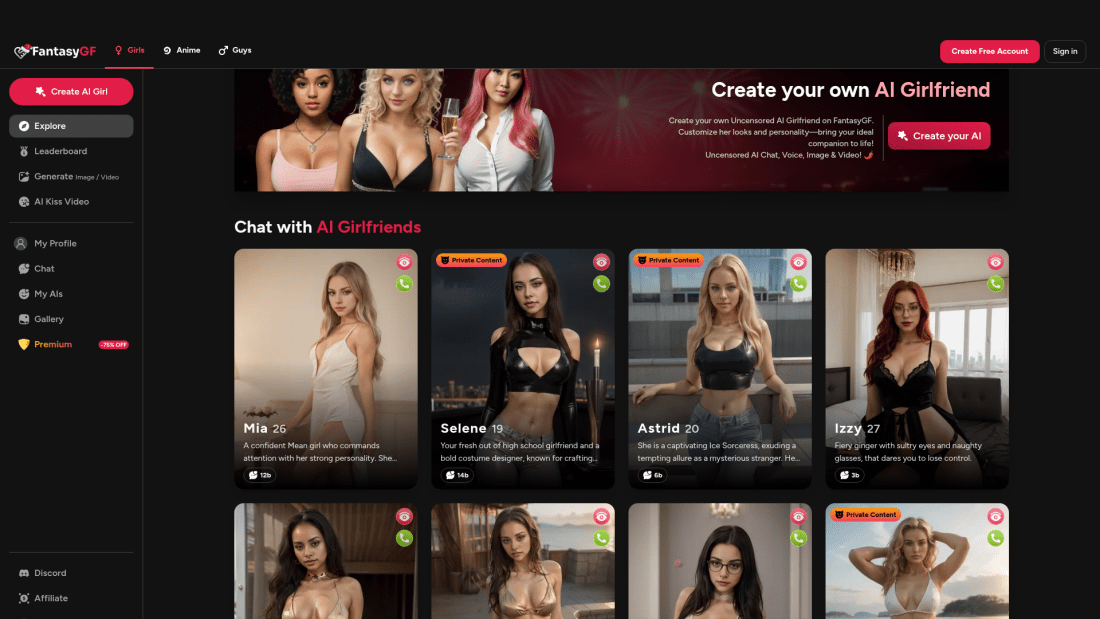
FantasyGF uses its name as a design asset. The fantasy and roleplay framing gives the AI contextual scaffolding that supports more creative, narratively coherent interactions than a generic companion product can sustain. Users arrive with a creative mindset, the platform meets them there, and the result is a product where the framing and the features reinforce each other well.
The interface design is cleaner than the category average, with a structure that guides users toward the features most likely to demonstrate value early. Character customisation is detailed and well-organised. Image generation quality is among the highest in this review. The most significant product gap is memory architecture — session-based context means each conversation starts fresh, and in a roleplay context where narrative continuity matters, that is a meaningful limitation.
Design Strengths
- Fantasy framing provides creative context that elevates both AI and user interaction quality
- Image generation quality is among the best in the category
- Interface structure guides new users toward value efficiently
- Character customisation is detailed and logically organised
Design Weaknesses
- Session-based memory limits narrative continuity across conversations
- Premium pricing requires upfront commitment before full feature access
Design Verdict: Strong creative platform. Solve the persistent memory problem and this becomes a top-five recommendation without qualification.
8. SpicyChat

SpicyChat makes a structural product decision that distinguishes it from every other platform in this review: user-created characters. The platform provides the AI infrastructure while the community generates the content. The result is a character library that is effectively unlimited and constantly evolving — a content model that no internally-produced roster can compete with on volume.
The trade-off is quality consistency. Community-created characters range from impressively crafted and deeply written to barely functional, and surfacing the good ones requires user effort that a curated platform would not demand. The interface reflects the open-platform philosophy — wide and functional rather than deep and refined. For users who value discovery and variety over consistent quality, SpicyChat has an argument no other platform can make.
Design Strengths
- Community creation model produces an enormous and continuously growing character library
- Free tier is genuinely expansive — one of the most accessible in the category
- Community structure creates ongoing discovery and re-engagement
Design Weaknesses
- Character quality is inconsistent — discovery UI needs significant improvement
- AI model quality varies between characters depending on underlying configuration
- Interface prioritises breadth over depth in ways that limit the polished user experience
Design Verdict: The community model is both the platform’s greatest differentiator and its most unresolved design challenge. A better discovery layer would change everything here.
9. GirlfriendGPT

GirlfriendGPT is a product built by people who care most about getting the AI right and treat the interface as a secondary concern. That prioritisation is visible throughout: the long-term memory system is among the best implemented in this review, the conversational AI has genuine depth and consistency, and the character personality holds up across extended sessions in a way that reflects serious work on the underlying model.
The visual design and interface are functional without being competitive. There is a strong early-product quality to the UI that suggests a team focused on capability over presentation — which is a reasonable prioritisation at an early stage, but creates a noticeable gap when placed next to platforms that have invested in their design layer. For users who weight conversation quality over interface quality, this is an overlooked option at its price point.
Design Strengths
- Long-term memory implementation is technically among the strongest in the review
- Conversational AI quality is consistently high — above-average depth and coherence
- Free tier offers meaningful access to the core product features
- Character personality consistency holds up across long and complex sessions
Design Weaknesses
- Visual design is functional but not competitive with the current market
- Onboarding does not adequately communicate the depth of what is available
- No voice or advanced image generation features
Design Verdict: Strong product fundamentals wrapped in interface design that does not represent them well. A serious UX investment could move this platform significantly up any ranking.
10. SoulGen

SoulGen enters this category from a different origin point: it is an AI image and character generation platform that has expanded into companion experiences. The result is a product with best-in-class visual output and a companion layer that feels like a strong secondary feature rather than the primary product. For any review that weights image generation heavily, SoulGen belongs at the top of the list.
The visual design and interface are polished and professional in a way that reflects the platform’s image-generation roots. The chat AI is capable. Character creation for visual output is exceptional — accessible to general users while offering depth that satisfies more demanding creative use cases. Users who arrive primarily wanting image generation will not be disappointed. Users who arrive wanting deep conversational engagement will find the companion features less developed than dedicated platforms.
Design Strengths
- Best-in-class AI image generation quality — not close
- Visual design and interface are polished and professional throughout
- Character creation for visual output is exceptional in both depth and accessibility
- Platform brings professional-grade tools within reach of general users
Design Weaknesses
- Companion conversation features feel secondary to the image-generation core
- No persistent memory system
- Voice features absent
Design Verdict: If image generation quality is your primary evaluation metric, nothing in this category touches SoulGen. If conversation depth matters equally, it is not the right call.
The Onboarding Test: First 60 Seconds
Onboarding is where most consumer products lose users before they have demonstrated value. We scored each platform on how clearly and quickly it communicated its core product proposition before introducing any payment requirement.
| Platform | Time to Value | Paywall Placement | Value Clarity | Mobile Ready | Onboarding Score |
| AIGirlfriends.ai | Under 2 min | Post-value demo | Excellent | Yes | 9 / 10 |
| Candy AI | Under 2 min | Early | Good | Partial | 7 / 10 |
| Kupid.ai | Under 3 min | Post-value demo | Excellent | Yes | 8 / 10 |
| CrushOn.ai | Under 2 min | Post-value demo | Good | Yes | 7 / 10 |
| DreamGF | Under 3 min | Post-value demo | Good | Partial | 7 / 10 |
| JuicyChat.AI | Under 1 min | Post-value demo | Direct | Yes | 7 / 10 |
| FantasyGF | Under 3 min | Early | Good | Partial | 6 / 10 |
| SpicyChat | Under 2 min | Post-value demo | Moderate | Yes | 7 / 10 |
| GirlfriendGPT | Under 2 min | Post-value demo | Moderate | Partial | 6 / 10 |
| SoulGen | Under 2 min | Post-value demo | Good | Yes | 8 / 10 |
The Build Quality Breakdown
A consolidated scorecard across the four design dimensions we weighted most heavily in this review. Scores reflect the overall product experience across multiple weeks of use.
| Platform | Conversation | Interface Design | Feature Architecture | Value Delivery | Overall |
| AIGirlfriends.ai | ★★★★★ | ★★★★★ | ★★★★☆ | ★★★★★ | ★★★★★ |
| Candy AI | ★★★★☆ | ★★★★★ | ★★★★☆ | ★★★☆☆ | ★★★★☆ |
| Kupid.ai | ★★★★☆ | ★★★★☆ | ★★★☆☆ | ★★★★☆ | ★★★★☆ |
| CrushOn.ai | ★★★☆☆ | ★★★☆☆ | ★★★☆☆ | ★★★★☆ | ★★★☆☆ |
| DreamGF | ★★★★☆ | ★★★☆☆ | ★★★★★ | ★★★★☆ | ★★★★☆ |
| JuicyChat.AI | ★★★☆☆ | ★★★☆☆ | ★★★☆☆ | ★★★☆☆ | ★★★☆☆ |
| FantasyGF | ★★★★☆ | ★★★★☆ | ★★★★☆ | ★★★☆☆ | ★★★★☆ |
| SpicyChat | ★★★☆☆ | ★★★☆☆ | ★★★★☆ | ★★★★☆ | ★★★☆☆ |
| GirlfriendGPT | ★★★★★ | ★★★☆☆ | ★★★☆☆ | ★★★★☆ | ★★★★☆ |
| SoulGen | ★★★☆☆ | ★★★★★ | ★★★★☆ | ★★★★☆ | ★★★★☆ |
What the Design World Is Missing by Ignoring This Category
AI companion apps are solving interaction design problems that will matter broadly in consumer software within the next few years. Persistent AI memory, emotionally adaptive conversation systems, multi-modal interaction across voice and image and text in a single coherent session — these are not niche challenges. They are the challenges that any product team building a complex AI-powered experience will eventually face.
The best platforms in this review show clear evidence of thinking carefully about these problems. The worst show none — and the difference is visible the moment you start interacting. There are also real design ethics considerations here: how platforms communicate the nature of AI interaction to users, how they handle emotional dependency design, how they architect for user wellbeing rather than pure engagement maximisation. These are conversations the product design community should be having about this category.
The AI companion space is iterating faster than most categories. The gap between what these platforms could offer and what they currently deliver is closing quickly. Designers and engineers who dismiss it are missing a front-row seat to some of the more interesting applied UX problems being actively solved in consumer software right now.
Final Design Recommendations
Best overall product and experience
AIGirlfriends.ai. Consistent quality across every dimension — onboarding, conversation, memory, interface, and value delivery. The benchmark for the category.
Best visual and image generation quality
SoulGen or Candy AI. SoulGen for image generation as the primary use case; Candy AI when you want strong visuals paired with a more capable companion experience.
Best for users who want creative depth and roleplay
DreamGF or FantasyGF. Both deliver feature richness and creative scaffolding that supports extended narrative engagement. DreamGF wins on customisation; FantasyGF wins on interface clarity.
Best free tier for testing the category
SpicyChat or CrushOn.ai. The most accessible no-cost experiences for users who want to evaluate the product before committing.
Best for conversation quality above all else
GirlfriendGPT. The AI and memory systems are the strongest technical implementation in the review. The interface will not win awards, but the product underneath it will.
Bottom Line: The AI companion category is moving fast and the quality gap between the best and worst platforms is wide. For design-aware users, these differences are visible from the first interaction. Choose accordingly — and start with the platform that has clearly done the most work to get the product right.